
What Makes a Nikah Legally Valid in Pakistan? Free Consent, Age and Sound Mind Explained

Written by Muhammad Adeel Chaudhry, Senior Partner
Published
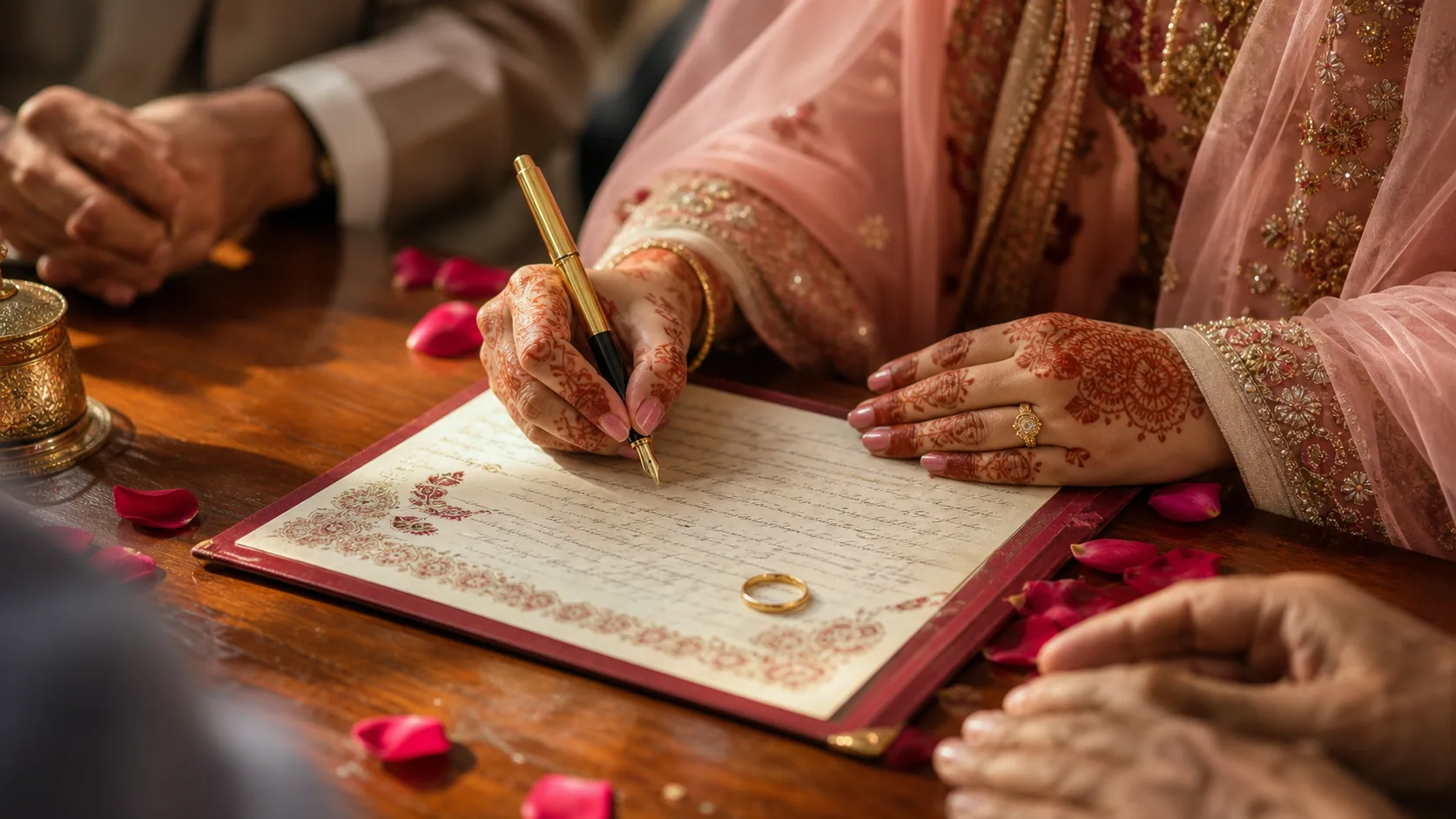
A nikah is more than a religious ceremony. Under Pakistani law it is treated as a formal civil contract, and like any contract, it is only valid if certain legal conditions are met. Many people assume that if a nikahnama is signed, the marriage is automatically valid. That isn't always true, and Pakistani courts have repeatedly struck down marriages, or refused to recognise them, where one of the underlying legal requirements was missing.
At Global Law Company, we regularly advise clients in Lahore and across Pakistan on exactly this question, whether it is to confirm a marriage's validity, contest one, or protect a family member from a forced or underage marriage. Here is what the law actually requires, and where to go for help if any of it is in doubt. For a broader look at how we support families through these matters, see our family lawyer in Pakistan guide.
1. Offer and Acceptance (Ijab-o-Qabul)
Every valid nikah begins with a clear offer (ijab) from one party and an unambiguous acceptance (qabul) from the other, made directly or through authorised representatives or guardians (wakeel). The Supreme Court of Pakistan reaffirmed this in Ambreen Akram v. Asad Ullah Khan (2026 SCMR 1), describing marriage under Islamic law as both a devotional act and a civil contract ('aqd) that requires the same clarity of intention as any other binding agreement. Vague or ambiguous exchanges that don't clearly demonstrate mutual intent to marry can leave a nikah's validity open to challenge.
2. Free Consent, Not Just a Signature
This is where a surprising number of disputes arise. A signed nikahnama is not proof of a valid marriage if the signature itself wasn't given freely.
Pakistani law borrows its test for free consent from general contract law: consent is not free if it is caused by coercion, undue influence, fraud, misrepresentation, or mistake (Contract Act 1872, sections 13 to 14). Where consent fails this test, the marriage agreement becomes voidable (section 19) and can be set aside if procured through undue influence (section 19-A).
This isn't just theory. In Haleema Bibi v. Azeem (2020 CLC 1691, Azad Kashmir High Court), a woman went straight to the police after her nikah ceremony to report that her signature and thumbprint had been taken under pressure from her father and the man she was told to marry. The court treated this as strong evidence that her consent had not been free, supporting her case for jactitation of marriage, a formal declaration that no valid marriage existed. The lesson is that a nikahnama with a signature on it is a starting point for proving marriage, not the end of the inquiry, if genuine consent is disputed.
3. Age, Being a Legal Adult
Pakistani law sets a minimum marriageable age, and it has recently been brought into line across the country's two largest provinces. The century-old Child Marriage Restraint Act 1929 originally defined a "child" differently by gender and province, but both Punjab and Sindh now fix the threshold at 18 for everyone:
- Punjab: 18 for both males and females under the Punjab Child Marriage Restraint Act 2026, which replaced the previous 18-for-males, 16-for-females split and made child marriage a non-bailable offence
- Sindh: 18 for both males and females under the Sindh Child Marriages Restraint Act 2013
Solemnising, contracting, or facilitating a marriage below these thresholds can carry criminal penalties for the adult party, the person who conducts the nikah, and even the parents or guardians involved. The Lahore High Court's discussion in Azka Wahid v. Province of Punjab (2025 PLD 1) examined the gender gap in Punjab's age thresholds, a gap the province has since closed through the 2026 Act, so this remains a fast-moving area of law worth confirming before any marriage near the age limit.
Practical takeaway: if either party is close to the relevant age threshold, this should be verified and documented before the nikah, not after.
4. Soundness of Mind
Like any contracting party, both spouses must be of sound mind at the time of the marriage. Pakistani courts apply the same test used for ordinary contracts (Contract Act 1872, sections 11 and 12): a person must be capable of understanding the transaction and forming a rational judgment about its effect on their interests.
Importantly, this is a functional test, not a blanket exclusion. In Muhammad Munir v. Umar Hayat (2023 SCMR 1339), the Supreme Court held that a serious physical condition, in that case paralysis, does not automatically mean someone lacks the mental capacity to transact business or enter a binding agreement. The real question is whether the person could understand what they were agreeing to, not whether they were physically or medically unwell.
5. Registration, the Nikahnama
Under section 5 of the Muslim Family Laws Ordinance 1961, every Muslim marriage in Pakistan must be registered, and the nikahnama serves as the principal documentary proof of the marriage. While the underlying contract can technically exist independently of paperwork, registration is what makes the marriage straightforward to prove, for matters ranging from inheritance and maintenance to divorce and custody, so it should never be skipped or delayed. Couples formalising a marriage without a large family ceremony should also read our guide to court marriage in Pakistan. For the paperwork that follows the ceremony, see how Nikahnama registration and the computerized marriage certificate work in practice.
Why This Matters Beyond the Ceremony
Getting these elements right isn't just a formality. Whether a marriage was validly contracted affects a spouse's right to maintenance, inheritance, custody claims, and the validity of any later divorce or khula. If any of these elements, consent, age, or mental capacity, is in doubt, it can be the basis for a legal challenge years after the nikah took place.
Nikah Validity Checklist
Run through this before, or after, a nikah is solemnised. If any item is uncertain, speak to a family lawyer before treating the marriage as settled.
- ✓A clear offer (ijab) and acceptance (qabul) were exchanged directly, or through an authorised wakeel.
- ✓Both parties gave free consent, without coercion, undue influence, fraud, or misrepresentation.
- ✓Both parties meet the minimum marriageable age for their province (now 18 for both males and females in Punjab and Sindh).
- ✓Both parties were of sound mind and able to understand the transaction at the time of the nikah.
- ✓The marriage has been registered under section 5 of the Muslim Family Laws Ordinance 1961, with a properly completed nikahnama.
Talk to a Family Lawyer Before or After Nikah
Whether you are planning a marriage and want the paperwork done correctly, need to verify or contest the validity of an existing marriage, or are concerned about a family member being pressured or married underage, our family law team can guide you through the process and represent you in Family Court if a dispute arises. Contact Global Law Company at 0333 4125951 or email [email protected], or visit our family law chambers at 3rd Floor, Ahmad and Shafi Plaza, 13 Fane Rd, Lahore, 54000.
Frequently Asked Questions
Is an unregistered nikah still valid?
A nikah can exist as a contract independently of registration, but registration under section 5 of the Muslim Family Laws Ordinance 1961 is what makes the marriage easy to prove. We always advise clients to register promptly rather than rely on an unregistered ceremony.
Can a family invalidate a nikah simply by disapproving of it?
No. Family disapproval alone does not invalidate a marriage between two consenting adults. What the law examines is whether the offer, acceptance, consent, age, and mental capacity requirements were actually met.
What can I do if I was pressured into signing a nikahnama?
If your consent was obtained through coercion, undue influence, or fraud, the marriage agreement may be voidable. We can advise on the available remedies, including a claim for jactitation of marriage, based on your specific facts.
Does a physical illness affect a nikah's validity?
Not automatically. Courts apply a functional test: whether the person could understand what they were agreeing to, not whether they were physically or medically unwell.
What is the minimum age for marriage in Pakistan?
In both Punjab and Sindh it is now 18 for both males and females. Punjab raised the age for women from 16 to 18 under the Punjab Child Marriage Restraint Act 2026, which removed the old gender gap, while Sindh has required 18 for everyone since the Sindh Child Marriages Restraint Act 2013. Marriage below the applicable age can expose the adult party, the person conducting the nikah, and the parents or guardians to criminal penalties.